

We are all just rolling the dice
How randomness shapes our lives, our thoughts, and our AI.

One of my best friends has been playing soccer pretty much forever. Every weekend—through sun, wind or rain—he’s back in the driver’s seat, driving to some random little town in the middle of nowhere for yet another league match. Last Sunday seemed just like any other, until it wasn't. He was pulling into the parking lot, ready to park, when the car ahead suddenly starts reversing—no warning, no checking mirrors—and BAM!, straight into him. Luckily no one was hurt, just a racing heart and an ugly dent on the driver's-side door. My friend was about to get out and check the damage when he realized that the driver wasn’t some random stranger: it was his own soccer coach! The man stepped out embarrassed, blurting: "I haven’t had an accident since 1980!". The whole incident ended in a mix of laughter and awkwardness.
Fast-forward three days. My friend is at a completely different sports complex for practice. He parks fine this time—no drama— and soon spots his coach hanging around, waiting for someone to unlock the gate to park his car. Being a helpful soul, my friend offers to track down the groundskeeper—and in the brief moment he’s gone, guess what happens? Coach crashes his car into another parked vehicle. That’s two identical incidents in about 72 hours, after four accident-free decades.
Now, these coincidences alone could already make you question life's randomness—but there’s one final twist. My friend could have shared this story with me at any moment, but he just so happened to tell me while we were pulling out of a parking spot ourselves. Literally the instant he finished the story, the car behind us backed up, same reversing scenario, and—you guessed it—crashed straight into another vehicle!
We exchanged a stunned glance, then burst out laughing. “Seriously, what are the odds?”
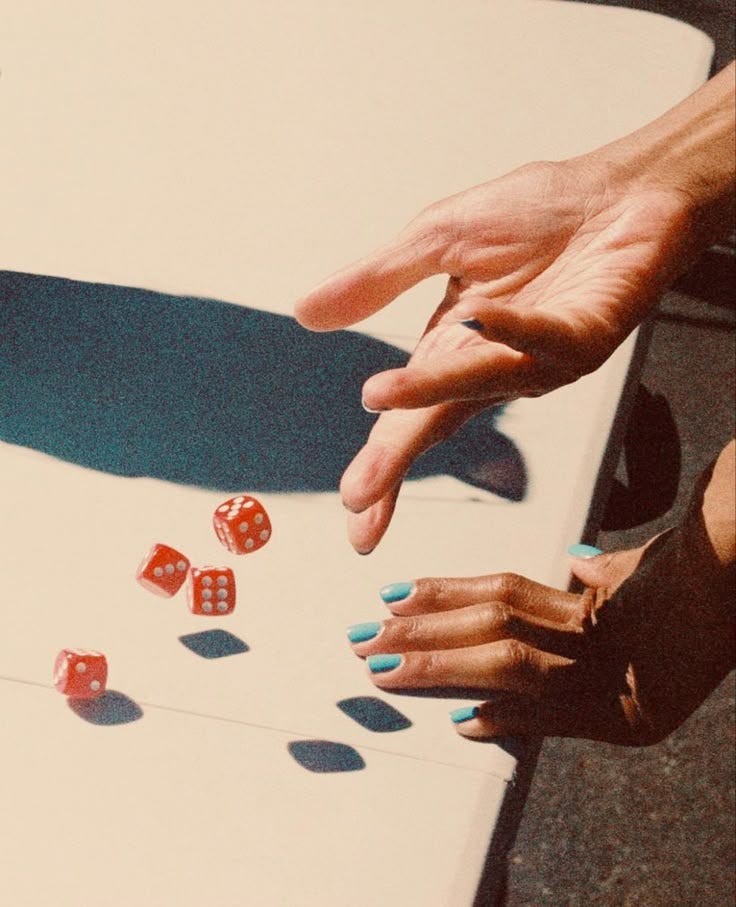
We humans have a hard time wrapping our heads around randomness. I mean, we cracked the DNA code, landed on the Moon, and developed tech that can outsmart us at chess. How can we accept that chance still runs the show? Yet randomness isn’t just part of our daily grind: it’s at the very core of Life with a capital “L”. If you’re reading these words on your phone right now, thank the countless random mutations in the DNA of all the creatures that came before us, spread out over billions of years.
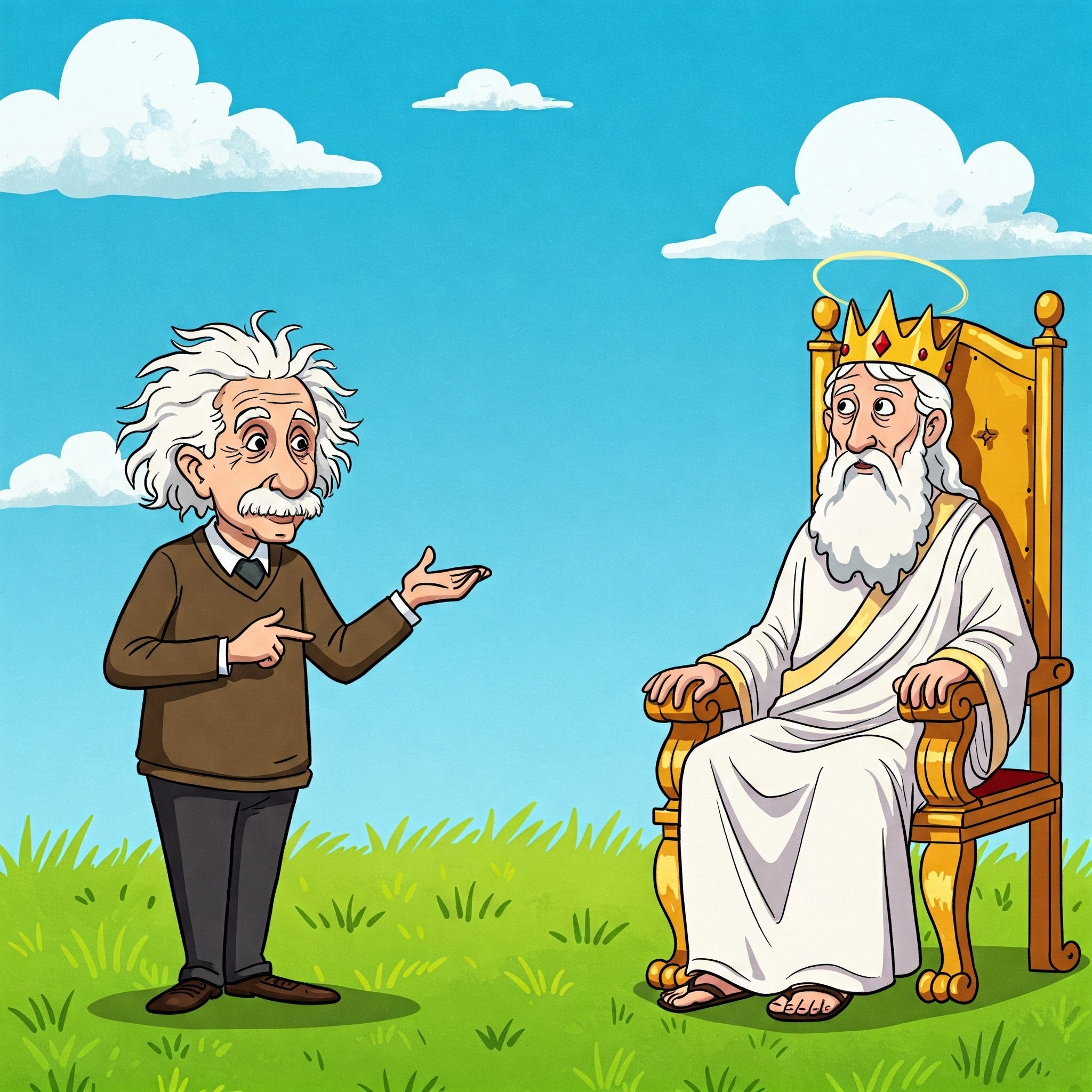
On one hand, accepting randomness takes a hefty dose of humility: you have to admit you don’t (and won’t) know it all. Imagine Physics a century ago, proudly wearing the crown of “We’ve got it all figured out”. Then along came Werner Heisenberg, shaking everything up with his uncertainty principle: suddenly, the tiniest particles weren’t dancing in neat, predictable steps but rolling the cosmic dice. Niels Bohr joined the party with his quantum model, and the old-school universe that was depicted as a Swiss watch turned into something more like a madhouse of monkeys on a sugar rush. Of course, not everyone was thrilled. Einstein—one of the sharpest minds of all time—famously said: “God does not play dice with the universe”. Bohr is said to have replied: “Einstein, stop telling God what to do”.
From another prospective, chance can actually set us free from the burden of trying to control every outcome. Ironically, embracing that uncertainty can help us live a little lighter. It’s no wonder the internet is full of pages asking “What if we rolled a dice for every decision?”. Letting chance decide for us can sometimes feel like the ultimate escape from having to get it right every single time.
Now, believe it or not, the same randomness that rules the cosmos, shapes life on Earth, and orchestrates wild parking-lot coincidences also powers the Artificial Intelligence we use every day.
Ever used ChatGPT, unlocked your iPhone with Face ID or played around with an AI music generator? All those fancy feats come down to something called Neural Networks. Under the hood, a neural network is basically a massive web of virtual “neurons” linked by numerical values called “weights”. These neurons pass signals around, loosely mimicking how our brains process information. But just as the universe itself emerged from chaos, these weights begin life with a “roll of the dice”—random numbers—before the system even starts to learn. Interestingly, it wasn’t always done this way. Early on, researchers tried to initialize these “weights” in a more static way. But they soon discovered that adding randomness made neural networks learn more effectively, giving them a spark of flexibility much closer to how our own brains seem to work.
The randomness doesn’t stop once the network has finished learning (or is “trained,” in AI jargon). Consider ChatGPT, for example. Have you noticed that even if you type the exact same question multiple times, there’s a good chance you’ll get slightly different answers? Why is that the case? Because ChatGPT doesn’t just spit out a single answer every time: it randomly picks from a range of possibilities. That little element of chance makes chatbots’ responses more varied and human-sounding. So, whether it’s cosmic events, the evolution of life, or the lines ChatGPT crafts in real time, randomness keeps things interesting in ways we’re still learning to appreciate.
There’s more. Ever seen those ultra-realistic AI-generated images that look just like the real thing? If so, you’ve probably come across Diffusion Models. Here’s the simple version of how they work.
They start from a perfectly clear image, let’s say an image of a dog. Then, they gradually tweak individual pixels, degrading the quality of the image. This process goes on until the pixels are so ruined that the dog is now unrecognizable. We say that the image now turned into “pure random noise”. Think of those old-school TVs at your grandparents’ place, where black-and-white static would take over whenever the antenna stopped working: that fuzzy mess is exactly what we aim for.
From here, the magic begins: we teach a neural network to reverses this process, i.e. from this pure noise, it reconstructs the original image, with the help of a textual description of what the image looked like before it was ruined. Once the neural network is ready, simply give it some random noise to start with and a request for what you want to generate... and that's it!
If you study the mathematics behind these models in detail (fair warning, proceed at your own risk), you will go through at least two stages before you are convinced that they work. At first you will think it is stupid. Then you will think it is black magic. Only after that you will finally see how all that apparent chaos can produce images and videos that look incredibly real. Personally, it took me a solid year to get to this stage.
As if that weren’t enough, things also start drifting into the philosophical. Every newly generated image is completely unique: nowhere else in the entire universe will you find that exact combination of pixels. In fact, since they start from pure noise, they will find different ways to converge to the final product every time. And remember, the Diffusion Model has never seen this specific image during training. Which raises the question: if an AI can come up with something brand new from scratch, is it truly being creative, just like a human artist?
We humans like to feel in control. We hate to admit that randomness is something deeper than just a bug in the system, a flaw in the matrix. We like to think that whatever is outside our control is an exception we can ignore. But the Universe, biological Life, human creativity, and now even Artificial Intelligence, all suggest otherwise.
Randomness isn’t the exception. It’s the rule. It’s not noise to filter out, but a signal to pay attention to. Maybe chance isn’t something to avoid. Maybe it’s something to listen to.
We like to think we’re in control. But the truth is: we are all just rolling the dice.
 | A guest post by
|
The coach was probably lying!
On a more serious note, I believe the universe deals us random cards, but then it’s on us to choose how to play them. Brilliant article.
Wow, brilliant!